



A medium or large employer sponsoring one Skilled Worker on a three-year Certificate of Sponsorship pays £4,485 to the Home Office when it assigns that certificate, and none of it can be passed to the worker. Cover the worker's own visa fee and healthcare surcharge as well, as many employers do, and the per-hire figure rises to £8,926.50. On a five-year certificate the two numbers are £7,125 and £14,435.50.
Those totals are built from five charges that sit on two different ledgers. Two belong to the employer by law. Two belong to the worker but are often picked up by the employer, and that choice has a salary consequence most budgets miss. The fifth, the licence, is paid once. This guide from Borderless Immigration sets out each charge at the fees in force from 8 October 2026, gives the per-hire total at three and five years, and scales it to a hiring plan you can hand to finance.
The per-hire cost at a glance
The tables assume a single adult worker applying from outside the UK for a role that is not on the Immigration Salary List and not on the Health and Care Worker visa. Each of those changes the number, and they are covered further down.
Three-year certificate
| Charge | Medium or large sponsor | Small or charitable sponsor |
|---|---|---|
| Certificate of Sponsorship fee | £525 | £525 |
| Immigration Skills Charge | £3,960 | £1,440 |
| Employer's mandatory total | £4,485 | £1,965 |
| Visa application fee (up to three years) | £819 | £819 |
| Immigration Health Surcharge (three and a half years) | £3,622.50 | £3,622.50 |
| Total if the employer pays everything | £8,926.50 | £6,406.50 |
Five-year certificate
| Charge | Medium or large sponsor | Small or charitable sponsor |
|---|---|---|
| Certificate of Sponsorship fee | £525 | £525 |
| Immigration Skills Charge | £6,600 | £2,400 |
| Employer's mandatory total | £7,125 | £2,925 |
| Visa application fee (over three years) | £1,618 | £1,618 |
| Immigration Health Surcharge (five and a half years) | £5,692.50 | £5,692.50 |
| Total if the employer pays everything | £14,435.50 | £10,235.50 |
Why the surcharge covers an extra half year: a Skilled Worker is granted permission until 14 days after the end date on their certificate (Appendix Skilled Worker, SW 18.1), and the surcharge charges any part year of six months or less at half the annual rate (Immigration (Health Charge) Order 2015, article 4(6)). A three-year certificate therefore carries three and a half years of surcharge, not three.
Spread across the life of the certificate, a medium or large sponsor's mandatory spend works out at £1,495 a year on a three-year certificate and £1,425 a year on a five-year one.
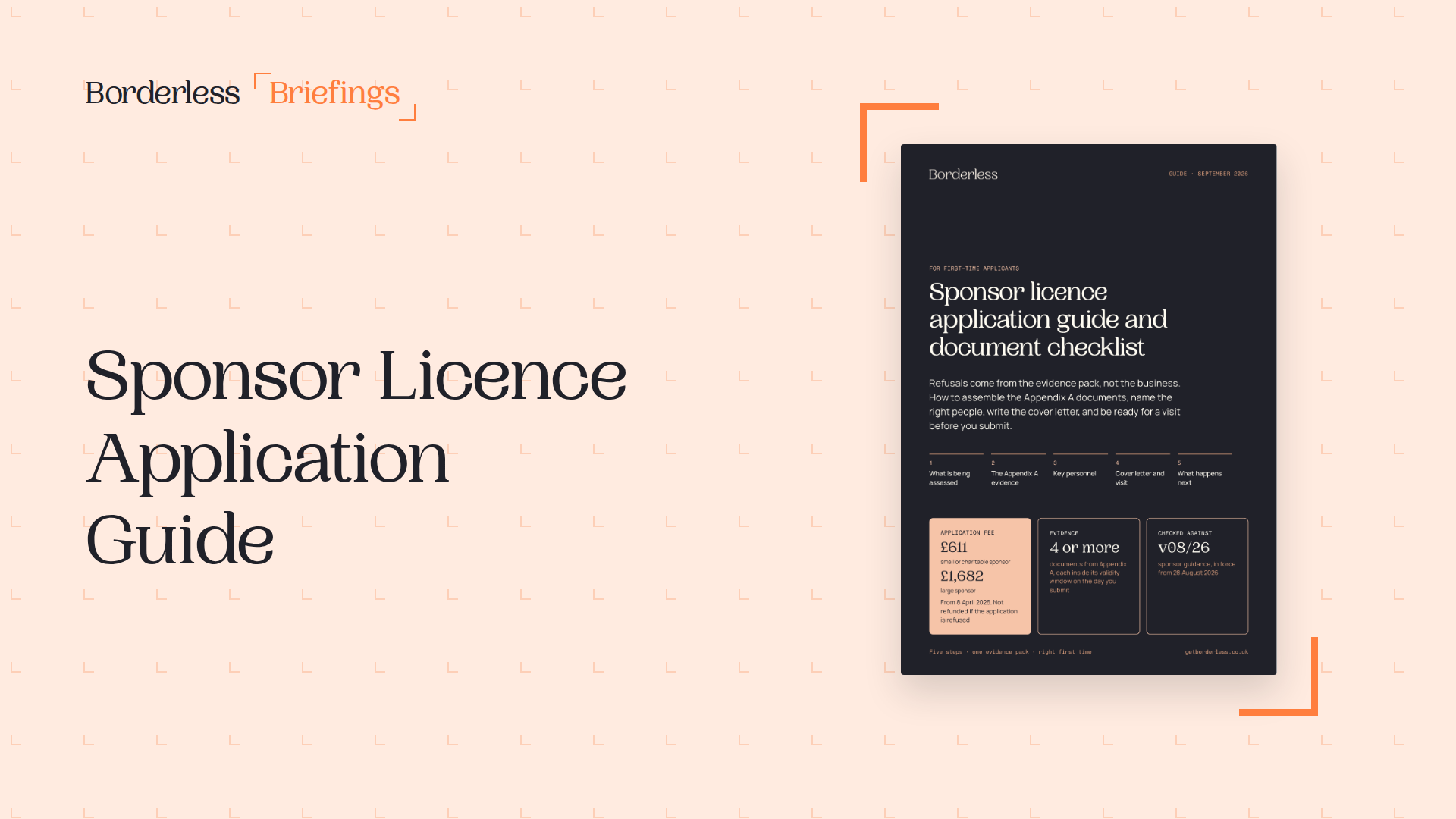
The licence sits on top, and you pay it once rather than per hire: £1,682 for a medium or large sponsor and £611 for a small or charitable one. It is not refunded if the application is refused (Part 1, L6.15). A licence stays valid indefinitely unless it is revoked or surrendered, with the Scale-up and UK Expansion Worker licences the only time-limited exceptions (sponsor guidance Part 1, L3.8). Across an intake of 50 hires, the licence adds about £34 each. If you need the decision faster, the priority service is a further £750 for a decision within 10 working days, and places are limited each day. The detail, including the fee for adding a route to an existing licence, is in our sponsor licence fees guide.
The two charges you must pay, and cannot pass on
The Certificate of Sponsorship (CoS) fee is £525 for every Skilled Worker certificate you assign. If the worker's application is refused, any administrative review is dismissed, and you still want to hire them, you assign, and pay for, a new certificate (Part 2, S6.6). If the application is rejected as invalid or withdrawn instead, the worker can reuse the same certificate while it is still valid (S6.7). Our Certificate of Sponsorship cost guide covers defined and undefined certificates in more depth.
The Immigration Skills Charge (ISC) is the larger of the two. A medium or large sponsor pays £1,320 for the first 12 months of employment stated on the certificate and £660 for each further six-month period. A small or charitable sponsor pays £480 and £240 (Part 2, S5.3 and S5.4). The charge for the whole period is paid in one go when you assign the certificate, not year by year, which is why a five-year certificate puts £6,600 on the card on day one. That cash-flow point matters more than the headline rate when you are hiring in batches.
The rate you pay follows the size or type recorded on your licence. Broadly, you are small if you fall within the small companies regime under section 381 of the Companies Act 2006, or if you are not a company and employ no more than 50 people, and charities pay the small rates whatever their size (Part 1, L6.13). If your size or status changes, you must report it within 20 working days (S5.6), and the new rate applies once the Home Office has processed and accepted the change (S5.5). A sponsor that becomes small only gets the difference back on certificates assigned after it told the Home Office (S5.20 and S5.21), so report promptly.
Neither charge can be passed to the worker. Part 1, L6.17 says the Home Office will normally revoke your licence if you recoup, or try to recoup, by any means, the licence fee or the CoS fee (including any associated administrative costs), or the ISC. For Skilled Workers the CoS fee rule applies to certificates assigned on or after 31 December 2024. The same conduct is listed among the grounds on which the Home Office will normally revoke a licence, at Annex C2 (q), (cc) and (dd) of Part 3. We set out the full rules in what employers can and cannot pass on to sponsored workers.
The two charges that belong to the worker
The visa application fee and the Immigration Health Surcharge (IHS) are the worker's to pay. Plenty of employers cover them as part of the offer.
| Skilled Worker application | Up to three years | Over three years |
|---|---|---|
| From outside the UK | £819 | £1,618 |
| From inside the UK (switch or extend) | £943 | £1,865 |
| Job on the Immigration Salary List | £628 | £1,235 |
| Health and Care Worker visa | £324 | £628 |
The Immigration Salary List and Health and Care fees are the same whether the worker applies from inside or outside the UK. Most entries on the Immigration Salary List come off on 31 December 2026, and an occupation only counts as listed where the application uses a certificate issued before its removal date (Appendix Immigration Salary List), so a discount you are budgeting for next year may not exist.
The IHS is £1,035 a year for an adult and £776 a year for anyone under 18 when they apply. Health and Care Worker visa holders and their dependants do not pay it at all, which is why the all-in cost of a care hire is so much lower than the tables above suggest.
Families multiply the worker-side cost, not the employer-side one. A partner or child pays the same visa fee as the main applicant for the same length of time, plus their own surcharge, but there is no ISC for dependants (S5.10). A worker coming from outside the UK on a three-year certificate with a partner and one child faces £2,457 in visa fees and £9,961 in surcharge, more than £12,400 before anyone has boarded a plane. If your offer says you will cover relocation costs, decide in writing whether that includes the family's immigration fees.
To price a particular role, length and family, use Borderless Immigration's visa fees calculator.
If you pay the worker's costs, check the salary test
The list of fees you must not recoup in L6.17 does not include the visa application fee or the surcharge, so covering them is a policy choice. L6.17 is silent on recovering them, and how you cover them is where sponsors get caught.
Money you pay towards a worker's immigration costs does not count as salary for the Skilled Worker threshold (Appendix Skilled Worker, SW 14.2(g)). And money the worker pays back to you, whether as deductions from salary or as repayments of a loan, is subtracted from their salary when the threshold is tested, averaged over the length of the sponsorship (SW 14.2A(a) and (b)). Recovering a relocation package through payroll can therefore pull a worker below the threshold you sponsored them at.
Take a worker on £42,000 in a role where the general threshold of £41,700 applies (SW 4.4, option A). You front their £819 visa fee and £3,622.50 surcharge, £4,441.50 in total, and recover it from salary over a three-year certificate. That is £1,480.50 a year, so the salary that counts is £40,519.50, which is below the threshold. The worker must also meet the going rate for the occupation code, so run the same test against that. The Skilled Worker salary calculator gives you the floor for a given role.
The exception in SW 14.2A(c) is narrow: money is not deducted where the payment is not related to business costs, immigration costs or investment, but is an additional benefit the worker has a genuine choice whether to take up, such as salary sacrifice. A deduction for immigration costs falls outside it by the rule's own wording.
What changes the number
Hiring someone already in the UK
The worker's visa fee is higher from inside the UK (£943 or £1,865), and an in-country application attracts the ISC for any length of employment, even under six months (S5.8). But the ISC disappears if, on the date you assign the certificate, the worker holds current permission as a Student, a Child Student, a Short-term Student (English Language), or on the old Tier 4 routes (S5.11). The exemption continues if you later assign a new certificate for the same role (S5.14). It does not cover the Graduate route, the dependant of a student, or permission that has already expired when you assign the certificate (S5.13), which are the distinctions most often missed.
Exempt occupations
Nine occupation codes carry no ISC, all in science, research and higher education teaching: 2111 to 2115, 2119, 2161, 2162 and 2311 (S5.9). A worker applying from outside the UK for less than six months is also exempt.
Extensions and role changes
Extending a worker's visa means a new certificate and a new £525 fee. The ISC is due only for the extra time: where the new grant would run beyond the worker's current permission, you pay for the additional period (S5.9). A move to a job with a different occupation code works the same way, with a new certificate and ISC for any added time. The worker pays the in-country visa fee and a fresh surcharge for the new period.
Refunds when a hire falls through or leaves early
The ISC is refunded in full if the worker's application is refused or withdrawn, if they are granted permission but never start, if the certificate expires unused, or if you withdraw it before it is used (S5.24). A certificate expires if it is not used within three months of being assigned (S5.25). If the worker leaves early, moves to another sponsor, or is granted a shorter period than the certificate states, the Home Office keeps the first 12 months and refunds any unused later six-month periods (S5.22 and S5.23). There is no refund if the worker changes job within your organisation, moves to another sponsor under TUPE, or if your licence is made dormant or revoked (S5.26).
Refund decisions are made within 90 days of the relevant event, such as your report in the sponsorship management system that the worker did not start or has left (S5.25). Build that lag into any forecast that assumes some attrition.
Paying for speed
Beyond the £750 licence priority service, the worker can pay £500 for the priority visa service or £1,000 for super priority, where those services are offered. These are the worker's fees unless your offer says otherwise.
Scaling it to a hiring plan
Start from the per-hire rate, multiply by intake, and add the licence once. For 50 Skilled Workers on three-year certificates at a medium or large sponsor, all applying from outside the UK as single adults:
| Line | Per hire | 50 hires |
|---|---|---|
| Employer's mandatory charges (CoS and ISC) | £4,485 | £224,250 |
| Worker's visa fee and surcharge, if you cover them | £4,441.50 | £222,075 |
| Total | £8,926.50 | £446,325 |
Of the £224,250, the £198,000 of ISC leaves the business as each certificate is assigned, not over three years. If the intake lands in one quarter, so does the bill. Put that in front of finance before the hiring plan is signed off, not after the first batch of certificates.
What to agree with finance before you hire
A sponsorship budget that survives scrutiny answers five questions, and each one changes the total above.
- The mandatory per-hire figure for your size band at the certificate lengths you plan to use.
- Whether you will cover the worker's visa fee and surcharge, and whether that extends to dependants.
- Whether any of it will be recovered, and if so, whether the salary still clears the threshold and the going rate after SW 14.2A.
- How many hires are likely to come from the Student route, where there is no ISC.
- What refund you can expect when someone leaves early, and when it will arrive.
The fees themselves are fixed and published. The difference between a budget that holds and one that drifts is whether those five decisions were made on purpose or by default, one offer letter at a time.
Fees are from the Home Office immigration and nationality fees table effective 8 October 2026 and the GOV.UK pages for sponsors, the Skilled Worker visa and the Immigration Health Surcharge. Paragraph references are to the Workers and Temporary Workers guidance for sponsors, Part 1 and Part 3 version 08/26 (valid from 28 August 2026) and Part 2 version 10/26 (valid from 8 October 2026), to Appendix Skilled Worker and Appendix Immigration Salary List of the Immigration Rules, and to the Immigration (Health Charge) Order 2015. All were read on 4 November 2026. The per-hire totals are our arithmetic from those published figures.
Automate Home Office Audits with Borderless
The Borderless platform provides a centralized system for all sponsorships, automating reminders for key tasks and ensuring best practices across your organization, simplifying audit preparation and ongoing compliance.