


If you pay staff a salary (not an hourly rate), you can still breach the National Minimum Wage (NMW) / National Living Wage (NLW) rules — often without realising it.
That’s because minimum wage compliance is not “is the salary above the minimum?” It is assessed by:
- what pay counts for minimum wage purposes, divided by
- the working time that counts,
- in each pay reference period (weekly, fortnightly, monthly).
If the average hourly rate falls below the legal minimum, you have an underpayment — even if the annual salary looks fine.
Quick links for employers
- GOV.UK minimum wage rates: https://www.gov.uk/national-minimum-wage-rates
- Check if someone is getting minimum wage (calculator): https://www.gov.uk/am-i-getting-minimum-wage
Related Borderless resources:
- National Minimum Wage (NMW) guide: https://www.getborderless.co.uk/blog/national-minimum-wage
- Right to Work Checks (for employers): https://www.getborderless.co.uk/blog/right-to-work-checks
- Sponsor Management System (SMS): https://www.getborderless.co.uk/blog/sponsor-management-system
Key takeaways
- Salaried staff are still covered by minimum wage rules (in most cases)
- Compliance is tested per pay reference period, not annually
- The biggest risks come from working time, deductions, and salary sacrifice
- April uprating creates “silent underpayment” if payroll changes are late
- HMRC enforces minimum wage and can require backpay and impose penalties
What are the UK minimum wage rates for April 2026?
The government announced the following minimum wage rates from 1 April 2026:
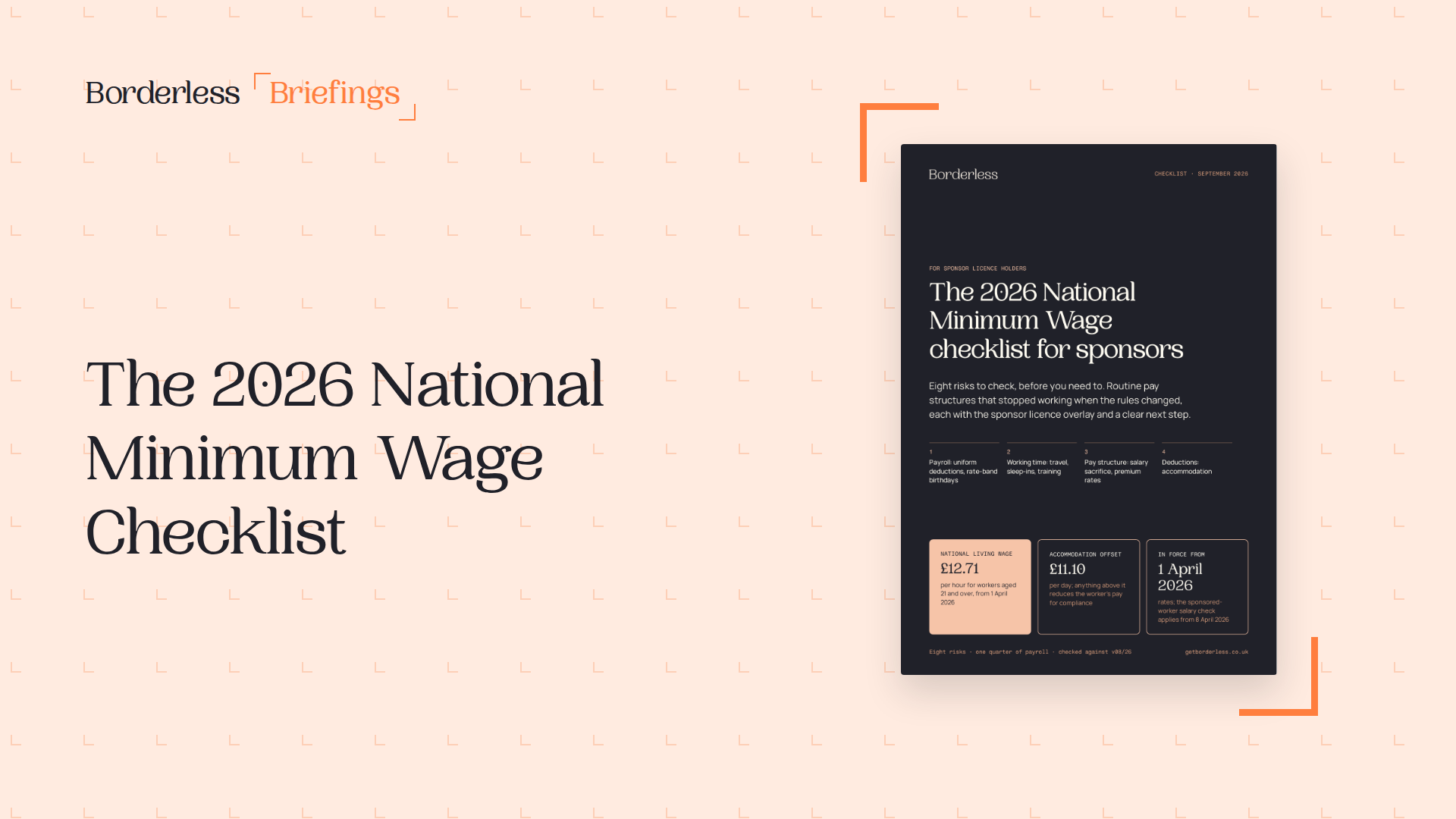
- National Living Wage (21 and over): £12.71 per hour
- 18–20 year old rate: £10.85 per hour
- 16–17 year old rate: £8.00 per hour
- Apprentice rate: £8.00 per hour
- Accommodation offset: £11.10 per day
Employer note: rates apply from the first pay reference period starting on/after 1 April — you cannot delay implementation to “match payroll cycles”.
Salary vs minimum wage: what employers must do
Minimum wage is a statutory pay floor. For employers, the practical requirement is:
In each pay reference period, a worker’s minimum-wage-counting pay divided by minimum-wage-counting hours must meet or exceed the applicable legal rate.
This is why salary compliance often fails: salary is fixed, but hours and deductions are not.
Who is entitled to minimum wage (and who isn’t)?
Minimum wage applies to most people legally classed as workers (a wider group than “employees”).
Typically entitled
- full-time and part-time staff
- casual / zero-hours workers
- many interns/work trials (fact-dependent)
- apprentices (with strict rules)
Common exclusions (narrow and fact-specific)
- genuinely self-employed people
- genuine volunteers
- certain student placements meeting strict criteria
If your model relies heavily on contractors, interns, trials, or “expenses-only” arrangements, this is a common risk area.
How to calculate minimum wage for salaried employees
Step 1: Confirm the pay reference period
Usually monthly. Minimum wage compliance is checked per pay reference period — not annually.
Step 2: Work out “pay that counts”
Not all elements of pay count towards minimum wage (and some things you might assume help, don’t).
Step 3: Work out “hours that count”
This may include more than just rostered time (depending on facts), such as mandatory training or required waiting time.
Step 4: Calculate the effective hourly rate
Effective hourly rate = minimum-wage-counting pay ÷ minimum-wage-counting hours
Compare the result to the worker’s legal minimum rate (age/apprentice status).
Fast sense-check: If a salaried role routinely runs overtime, handovers, training, travel between sites, or unpaid admin, you should assume it needs testing.
Why “salary above minimum wage” can still be non-compliant
1) Regular unpaid hours dilute the hourly rate
Common examples:
- early starts/late finishes
- unpaid handovers
- admin after shifts
- “expected” overtime not captured
2) Mandatory training time isn’t accounted for
If training time counts as working time on the facts, it increases hours with no increase in pay.
3) Deductions reduce pay for minimum wage purposes
Even contractually lawful deductions can reduce minimum-wage-counting pay below the threshold.
The biggest compliance traps: deductions, salary sacrifice, uniforms, accommodation
Uniforms and required clothing
If staff must pay for uniforms (or you deduct uniform costs), this can reduce minimum wage pay.
Salary sacrifice arrangements
Salary sacrifice can push cash pay below the legal minimum even if the headline salary looks compliant.
Employer-connected costs
Charges for tools, equipment, admin, or anything required for the job can create underpayment exposure.
Accommodation
Accommodation has a special rule set. The accommodation offset for April 2026 is £11.10/day.
Incorrect charging/deductions around accommodation is a known enforcement hotspot.
Apprentices: where employers most often get it wrong
The apprentice rate is tightly constrained (age and first-year rules). Underpayments commonly happen when employers:
- keep apprentices on the apprentice rate beyond eligibility, or
- fail to uplift pay at the right milestone (age threshold / end of year one)
If you employ apprentices, build automatic payroll triggers and audit them.
What happens if you get minimum wage wrong?
Minimum wage enforcement is led by HMRC, and the consequences can be significant.
Potential outcomes include:
- required backpay/arreas
- financial penalties
- reputational damage (including public naming policies in some circumstances)
Employees can use the GOV.UK tool to check pay:
https://www.gov.uk/am-i-getting-minimum-wage
How to build a defensible “salary minimum wage” compliance framework
Treat minimum wage as a repeatable control process, not a one-off salary decision.
1) Run an annual April uprating plan
- update payroll rates on time
- re-test salaried roles against real working patterns
2) Govern working time
- define what counts (training, handovers, waiting)
- ensure time capture reflects reality
- fix “unpaid norms” that dilute hourly compliance
3) Audit deductions and salary sacrifice
- map every deduction/cost
- test minimum wage impact per pay reference period
- put approvals around new deductions/schemes
4) Add exception reporting
Flag:
- effective hourly rates close to the legal floor
- high overtime patterns
- large deductions in low-paid groups
5) Keep an audit trail
If you cannot evidence your calculation logic and checks, you may struggle under scrutiny.
Borderless resources that support this broader compliance posture:
- National Minimum Wage (NMW) guide: https://www.getborderless.co.uk/blog/national-minimum-wage
- Right to Work checks: https://www.getborderless.co.uk/blog/right-to-work-checks
Minimum wage + immigration: an extra risk for sponsors
If you sponsor migrant workers, pay and role details should remain consistent with what was sponsored/contracted and what is recorded. Helpful Borderless reads:
- Certificate of Sponsorship (CoS): https://www.getborderless.co.uk/blog/certificate-of-sponsorship
- Sponsor licence revoked: https://www.getborderless.co.uk/blog/sponsor-licence-revoked
- Sponsor Management System (SMS): https://www.getborderless.co.uk/blog/sponsor-management-system
When to seek help from qualified experts (including Borderless)
Minimum wage breaches are rarely intentional — but salaried work patterns, deductions, and salary sacrifice make compliance easy to get wrong at scale.
It’s sensible to get support if:
- salaried teams work variable/unrecorded hours
- you operate uniforms, salary sacrifice, or accommodation
- you have large early-career or apprentice cohorts
- you want a defensible audit trail before complaints or HMRC scrutiny
Borderless supports employers with compliance-first operations, including:
- Mock audits and compliance readiness checks: https://www.getborderless.co.uk/mock-audits
- Sponsorship management and compliance: https://www.getborderless.co.uk/sponsorship
- Visa processing support: https://www.getborderless.co.uk/visa-processing
FAQs: salary minimum wage
If I pay a salary, do minimum wage rules still apply?
Yes, in most cases. Salary does not exempt you from minimum wage.
Does an annual salary above minimum wage guarantee compliance?
No. Minimum wage is tested per pay reference period and can be undermined by hours, unpaid time, or deductions.
What’s the fastest way to sense-check a salaried worker?
Calculate minimum-wage-counting pay ÷ minimum-wage-counting hours for the pay period and compare to the legal rate.
Where can I check official rates and tools?
Automate Home Office Audits with Borderless
The Borderless platform provides a centralized system for all sponsorships, automating reminders for key tasks and ensuring best practices across your organization, simplifying audit preparation and ongoing compliance.